

Last Modified:
September 29, 2026
Starting a Merchant Cash Advance business in the USA comes down to an early choice. Will you work as a broker or ISO, or will you fund transactions yourself?
For most people entering the industry, brokering is the more practical place to begin. A broker or Independent Sales Organization connects qualified business owners with direct funders, helps move files through underwriting, and earns a commission after a deal funds. You do not need capital to fund the advances yourself, but you do need funder relationships, a sound qualification process, secure document handling, and a dependable source of merchant leads.
Direct funding is a separate business with different demands. It requires capital, underwriting standards, servicing systems, compliance controls, collection procedures, and reserves for losses. Most operators move into direct funding only after they understand why files are approved, declined, renewed, or restructured.
Merchant financing demand remains substantial. In the Federal Reserve’s 2026 Small Business Credit Survey, 38% of employer firms said they had applied for a loan, line of credit, or merchant cash advance during the previous 12 months.
This guide shows you how to start an MCA business in the United States, build the right foundation, work with funders, qualify merchants, generate leads, and avoid the compliance mistakes that can damage a new brokerage or funding company.
Before buying leads or submitting files, understand what an MCA offer means for the merchant.
As a broker or ISO, you need to explain the transaction accurately, spot whether the merchant can handle the remittance, and avoid promises that the funder’s agreement does not support.
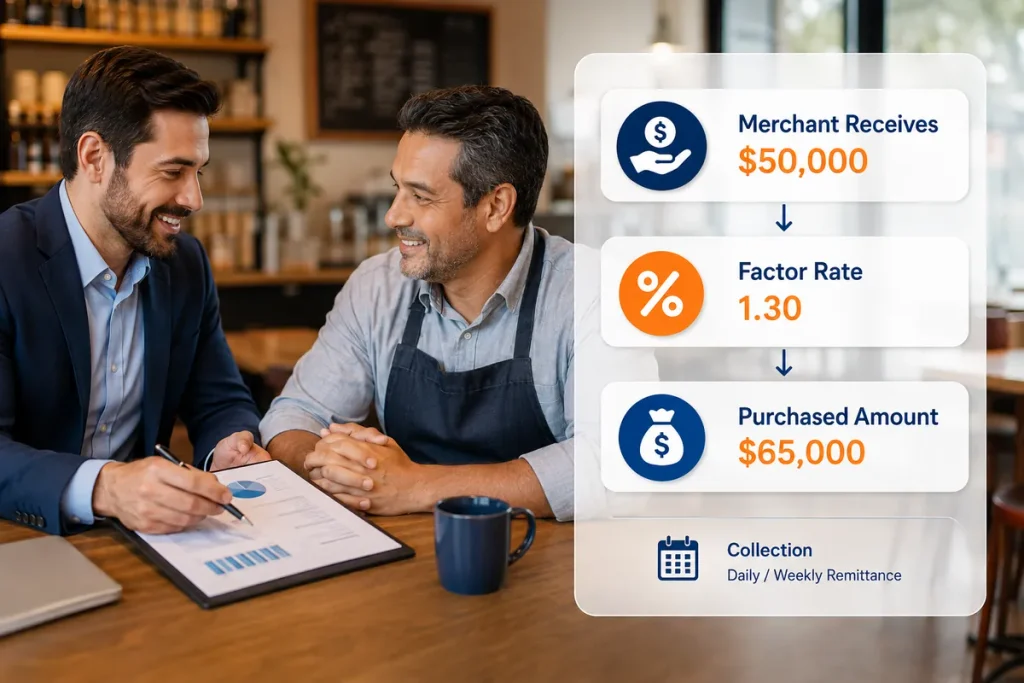
A Merchant Cash Advance is generally structured as the purchase of a business’s future receivables. The funder provides an upfront amount, while the merchant agrees to sell a stated amount of future business revenue.
An MCA agreement commonly includes:
For example, a merchant who receives $50,000 at a 1.30 factor rate has a purchased amount of $65,000.
$50,000 × 1.30 = $65,000
The factor rate shows the total purchased amount. It does not, by itself, show the annual cost or how long collection will take. The remittance amount, collection frequency, business revenue, and contract terms all affect the pressure on the merchant’s cash flow.
Do not describe every MCA as automatically flexible or tell a merchant that payments will always decline when sales drop. It is also not the same as a conventional business loan. Read the actual funder agreement and explain the terms that apply to that specific offer.
The FTC and New York Attorney General have taken action against MCA companies over allegations involving misleading terms, undisclosed fees, fixed withdrawals, and improper collection practices. For a new broker or ISO, the practical lesson is to market accurately, disclose the offer clearly, and work with funders whose contracts and servicing practices you understand.
Your business model determines how you earn, how much capital you need, and the risk you take on after a deal funds.
If you are new to the industry, you do not need to take portfolio risk immediately. Start with the model you can run properly today.
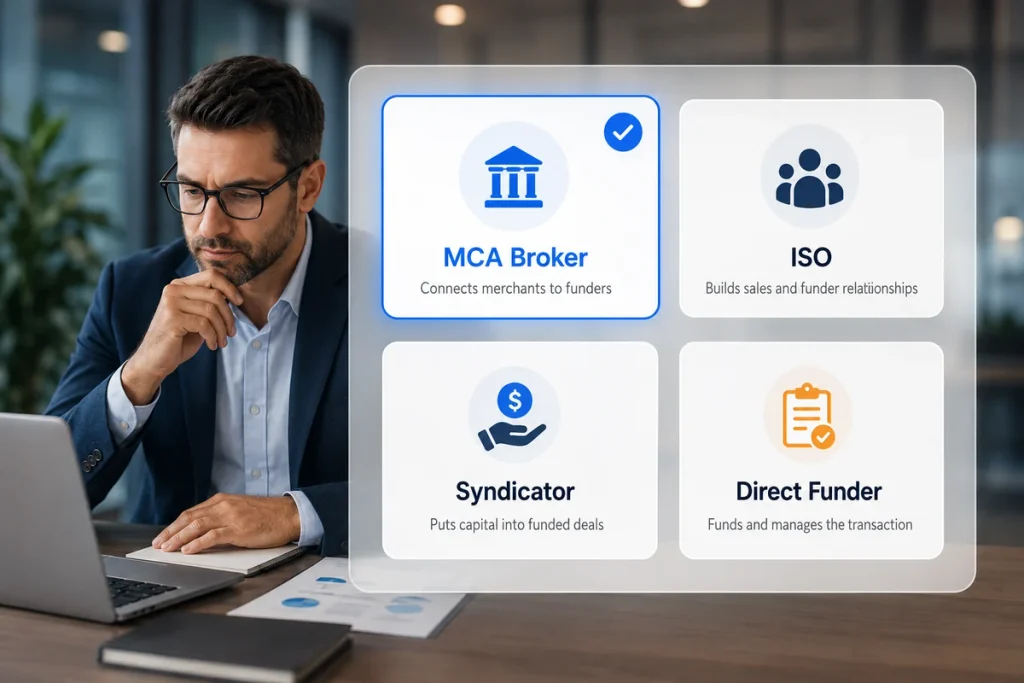
| Model | What you do | How you earn | Capital need | Best fit |
| MCA broker | Introduces qualified merchants to funders and submits funding files | Commission after a deal funds | Operating budget only | New entrants learning sales and funder criteria |
| ISO | Works under funder agreements, often with a sales team, referral network, or deeper merchant involvement | Commissions, sales overrides, and sometimes renewal-related revenue | Operating budget, sales, and compliance costs | Brokers with proven submission quality and funder relationships |
| Syndicator | Contributes capital to a funder’s transactions through a participation agreement | A share of collections or deal profit, based on the agreement | Capital committed to deals | Operators who understand portfolio risk |
| Direct funder | Purchases future receivables directly and manages the transaction | Revenue from funded transactions | Significant funding capital and loss reserves | Established operators with underwriting and servicing capacity |
The terms “broker” and “ISO” do not always mean exactly the same thing in the MCA industry. In many cases, an ISO works much like a broker but has direct funder agreements, more responsibility for sales activity, or a team of representatives. Read the agreement instead of relying on the title.
A broker’s job is to bring the right merchant file to the right funder. The broker does not supply the capital, but still needs a dependable lead source, secure document handling, compliant marketing, and a working knowledge of each funder’s underwriting rules. Commission agreements may also contain clawback terms if a funded deal defaults or is cancelled early.
A syndicator contributes capital but may not control underwriting or servicing. Before participating in a deal, find out who selects the merchant, who handles collections, how losses are shared, when capital is returned, and whether you can review portfolio performance.
A direct funder has more control and may keep more gross revenue per funded deal. It also pays for underwriting, capital, servicing, legal support, collections, technology, fraud controls, defaults, and restructures. Higher gross revenue does not automatically mean higher net profit.
For most new operators, brokering is the safer entry point. Move into an ISO, syndication, or direct-funding model only when your capital, compliance process, and operating experience can support it.
Do not market to every business that needs capital. A broad target usually produces weak messaging, poor lead quality, and files that do not fit your funders’ underwriting criteria.
Choose one or two merchant types that you understand, can reach, and can place with your funder network. Your niche should fit your lead-generation plan and the industries your funders are prepared to consider.
Before buying leads or launching campaigns, create an ideal-deal profile for each niche.
| Qualification area | What a good fit looks like |
| Business type | The industries you will target first |
| Merchant location | States you are prepared to serve and review for compliance |
| Time in business | The minimum operating history your funders usually require |
| Monthly deposits | Revenue range that supports the funding amount requested |
| Funding request | Typical amount and business purpose you want to pursue |
| Existing positions | Whether your funders accept merchants with current MCA or loan obligations |
| Cash-flow pattern | Stable, verifiable deposits and manageable existing debits |
| Documents available | Bank statements and business information needed for submission |
A broker might start with established service businesses, restaurants, or trucking companies that have consistent deposits and a clear working-capital need. That focus makes sales messaging clearer and makes it easier to work with funders who already understand those businesses.
Revenue alone does not make a deal strong. You also need to understand how the business earns, spends, and deposits money.
Restaurants may have frequent card deposits, but margins can be tight and sales may change with seasonality, staffing, or location. Trucking companies can show strong gross deposits while fuel, insurance, repairs, driver pay, and equipment payments strain cash flow. E-commerce businesses may grow quickly but still face seasonal revenue, ad costs, returns, chargebacks, and inventory expenses. Construction and service companies can have large deposits, yet payment timing may depend on completed jobs, invoices, retainage, or seasonal demand.
Choose merchants whose business model you can explain to a funder and whose revenue pattern you can assess from their bank statements. The goal is to find merchants with a reasonable funding purpose, verifiable revenue, and a profile that fits your funder network.
As you fund more deals, refine the profile with your own results. Track the industries, revenue ranges, funding amounts, and lead sources that produce the strongest approval rate, funding rate, renewal rate, and net commission.
Set up your business before collecting merchant bank statements, identification, or funding applications. Funders need to trust your submissions, and merchants need confidence that their financial information is handled properly.
Your setup should cover three areas.
| Area | What to set up |
| Business and finance | Legal entity, EIN, business bank account, accounting process, and commission tracking |
| Merchant operations | Professional email, business phone, website, CRM, application process, and clear file ownership |
| Data protection | Privacy policy, secure document upload, access controls, staff permissions, and a process for retaining or deleting documents |
Choose a legal entity that suits your ownership, tax, and liability situation. Many MCA brokers use an LLC or corporation, but the right structure depends on your circumstances. A legal and tax professional can help with that decision.
Your website should say exactly what you do. If you are a broker or ISO, do not present the company as a direct funder unless that is true. Explain how merchants can request funding, what information you collect, and how you may share it with funding partners.
Before accepting applications, set up:

Do not ask merchants to send bank statements or identification through personal email accounts, text messages, or unapproved shared inboxes. Use a secure upload portal or another approved protected method, and limit access to people who need the documents to evaluate or process the file.
Forming the company does not itself make you compliant to market, broker, or fund MCA transactions in every state. It gives you the foundation for the compliance work that follows.
Do not start advertising, buying leads, cold calling, or accepting applications until you know where you will operate and what role you will play.
There is no single nationwide MCA license that allows a company to market, broker, or fund deals in all 50 states. Requirements can depend on the merchant’s location, your role, the transaction amount, the product structure, and how the offer is marketed and serviced.
Commercial-financing rules vary by state. Some jurisdictions require disclosures, registrations, or specific practices for covered commercial-financing or sales-based financing transactions. California, New York, and Virginia are examples of states with important rules in this area, but coverage, exemptions, and effective dates differ. Review the law in every state you plan to serve with qualified legal counsel.
Work through compliance in this order:
Your legal and compliance review should cover:
The FTC has stated that unfair or deceptive conduct can create risk for financing providers, brokers, ISOs, lead generators, servicers, and debt collectors. A broker cannot rely on a funder’s name or contract to excuse misleading marketing or poor sales conduct.
Direct funders have additional responsibilities because they control underwriting, agreements, funding, servicing, and collections. They should also monitor whether the CFPB’s small-business lending rule applies to covered credit transactions they originate. The CFPB revised Regulation B in May 2026, with compliance beginning January 1, 2028. The rule does not automatically apply to every MCA structure, so direct funders should seek legal advice on coverage.
Compliance belongs in the operating model from the start. It affects merchant treatment, funder relationships, commissions, and the company itself.
Your funder network determines which merchants you can help, how quickly you can respond, and whether your deals have a realistic chance of funding.
Do not depend on one funder. Build relationships with several direct funders that cover different deal profiles, such as stronger-credit merchants, lower-credit merchants, businesses with existing positions, or particular industries. That gives you options without trying to force every merchant into the same program.
Create a funder profile in your CRM or submission sheet for each relationship.
| Review area | What to confirm |
| Credit box | Industries, states, minimum time in business, monthly deposits, credit expectations, and prohibited businesses |
| Existing obligations | Whether the funder accepts merchants with current MCA positions, loans, tax liens, or daily debits |
| Deal structure | Funding range, factor-rate range, remittance schedule, term expectations, and reconciliation process |
| Documentation | Required bank statements, identification, application, voided check, processing statements, and stipulations |
| Turnaround time | Typical time for underwriting, offers, stipulations, and funding |
| Commission terms | Commission percentage, payment timing, clawback conditions, and dispute process |
| Renewals | Who owns the renewal relationship and whether the broker earns renewal commission |
| Merchant contact | Whether the funder contacts the merchant directly and what communication the broker can expect |
| Compliance and data | Merchant-consent process, disclosure responsibilities, data-sharing rules, and complaint handling |
Before signing a broker or ISO agreement, ask questions such as:
Read more than the commission percentage. Pay attention to clawbacks, renewal ownership, non-circumvention language, merchant-contact rules, data use, and whether the funder can market directly to merchants you introduce.
Get the merchant’s permission before sharing a file with funding partners. Even with permission, do not send the same file to every funder in your network. Broad, unplanned submissions can trigger duplicate outreach, inconsistent offers, and a poor merchant experience.
Review the merchant’s revenue, existing obligations, industry, location, and funding need first. Then submit the file to the two or three funders whose credit box and deal structure are the closest match.
Funders value brokers who submit complete files, share accurate information, follow up promptly, and set realistic expectations with merchants.
Pre-qualification is not underwriting.
A broker or ISO collects accurate information, identifies obvious deal concerns, and matches the merchant with a suitable funder. The funder makes the final underwriting and funding decision.

Start with a short discovery call before asking for documents. Confirm the business type, location, time in business, average revenue, funding amount requested, use of funds, and existing financing obligations. This avoids collecting sensitive documents for files that clearly do not fit your funder network.
With the merchant’s permission, collect the documents required by the funders you plan to approach. A typical MCA file may include:
When reviewing bank statements, look beyond total monthly deposits. Review the whole cash-flow pattern.
| What to review | Why it matters |
| Average monthly deposits | Helps determine whether the requested amount is realistic |
| Deposit consistency | Shows whether revenue is stable, seasonal, or declining |
| Negative balances and overdrafts | May indicate cash-flow strain |
| NSF activity | Can signal payment issues or account instability |
| Existing daily or weekly debits | Shows current financing pressure |
| Large unusual deposits | May be a one-time deposit, loan proceeds, owner transfer, or non-recurring revenue |
| Declining deposits | May reduce the merchant’s ability to carry another remittance |
| Multiple financing positions | Can indicate stacking and higher payment risk |
| Returned payments or account restrictions | May create funding or servicing concerns |
When something looks unusual, verify it with the merchant instead of guessing. A large deposit might be normal business revenue, an insurance payment, a tax refund, a loan advance, or an internal transfer. Clear notes help the funder understand the file and can prevent avoidable declines.
Before submitting the application, compare average deposits and existing daily obligations with the likely remittance from a new offer. Consider whether the business could reasonably carry another payment if revenue stays flat or falls.
Classify each file before sending it out:
This process improves approval rates and helps you avoid steering merchants toward financing that does not fit their current cash flow.
Every merchant file needs a clear owner, a next action, and a due date.
A lead should stay in the pipeline until it funds, receives a recorded decline, or closes because the merchant no longer wants funding.
| Stage | What happens | What your team records |
| New lead | A lead enters the CRM and is assigned to a representative | Lead source, owner, date received, and next action |
| Initial qualification | Confirm business type, location, deposits, funding request, and current obligations | Basic merchant profile and fit notes |
| Documents requested | Explain what is needed and obtain permission to share the file with selected funding partners | Documents requested, consent, and follow-up date |
| File review | Review the application, bank statements, existing positions, and supporting documents | Funder-match notes and unresolved questions |
| Submitted | Send the file to suitable funders | Funder name, submission date, and documents sent |
| Offer or stipulations | Track offers, conditions, declines, and missing documents | Offer details, stipulation list, and next owner |
| Merchant review | Explain the offer and answer process questions | Merchant decision, concerns, and follow-up date |
| Contract and funding | Confirm final documents, signing, and funding status | Funded amount, funder, funding date, and commission |
| Renewal follow-up | Stay in contact after funding and review future eligibility | Renewal date, current funder, and follow-up owner |
| Closed lost | Record why the deal did not fund | Specific loss reason and whether later follow-up makes sense |
The owner of each step should be obvious. When a merchant submits bank statements, the team should know who reviews them. If a funder sends stipulations, one person should own the follow-up. Expiring offers should be visible in the CRM.
Record every decline reason. Common reasons include insufficient deposits, declining revenue, high NSF activity, active stacking, restricted industry, short operating history, incomplete documents, or a merchant who decides not to proceed.
These records show where the process needs work. You may find that a lead source sends businesses outside your target profile, a representative requests documents too early, or a funder is not a good fit for your niche.
Your CRM should show where every merchant is in the process, who owns the file, which funders received it, and what happened after submission.

At a minimum, track the following.
| Category | Information to track |
| Lead information | Lead source, date received, campaign, merchant contact details, industry, and state |
| Sales activity | Assigned representative, call attempts, emails, notes, next action, and follow-up date |
| Qualification | Time in business, requested amount, deposits, existing positions, funding purpose, and fit notes |
| Documents | Application status, documents received, missing items, and secure document location |
| Funder activity | Funders submitted to, submission date, offers, stipulations, declines, and decline reasons |
| Funding outcome | Funded amount, funder, funding date, gross commission, and commission payment date |
| Long-term performance | Renewal date, repeat funding, refunds, clawbacks, chargebacks, and final deal outcome |
Use consistent pipeline stages, such as New Lead, Contacted, Qualified, Documents Requested, File Ready, Submitted, Offer Received, Stipulations, Funded, Nurture, and Closed Lost.
Avoid vague statuses like “working on it” or “follow up later.” Each active file should have a named owner and a dated next step.
Merchant bank statements and identification documents need stronger controls than ordinary lead data. Limit access based on each team member’s role, use secure storage, and do not share documents through personal email accounts or unapproved messaging channels. Keep CRM notes factual and professional. A funder or complaint reviewer may read them later.
A lead-generation system should produce qualified merchant conversations consistently, not just a large contact list.
Begin with one or two channels that fit your niche, budget, and sales capacity. Testing every channel at once makes it difficult to see which sources generate applications, funded deals, or poor-quality leads.
| Channel type | Examples | Best use |
| High-intent inbound | SEO, paid search, real-time web leads, live transfers | Reaching merchants actively looking for funding |
| Outbound prospecting | UCC data, cold calling, compliant email outreach, targeted business lists | Building volume when your sales process is disciplined |
| Referral relationships | Accountants, consultants, equipment vendors, insurance agents, and business-service partners | Reaching merchants through trusted introductions |
| Re-engagement | Past applicants, declined merchants who may now qualify, and renewal opportunities | Using contacts already in your CRM |
Each channel needs a clear offer, target merchant profile, consent process where required, and follow-up plan.
A real-time lead may need faster follow-up because the merchant recently requested information. A UCC-based prospect list usually needs more filtering, more contact attempts, and a longer sales cycle. Referral leads may carry more trust but arrive in lower volume.
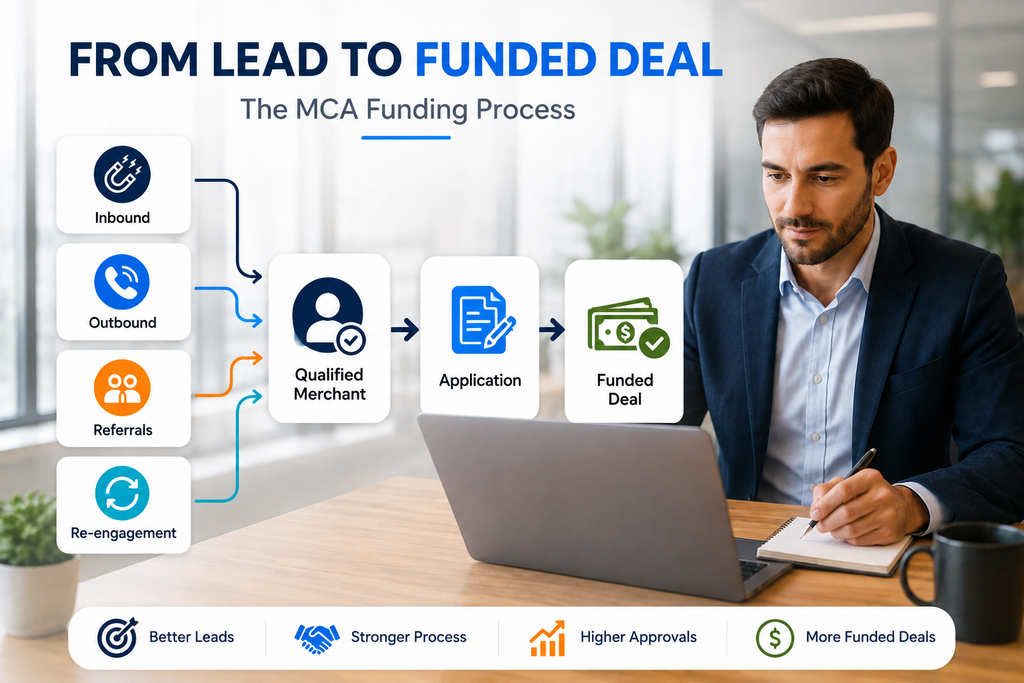
Cost per lead is only one measure. Track whether each source produces real conversations, completed applications, fundable files, commissions received, and profitable repeat business.
A merchant seeking capital quickly may be under pressure. Explain the offer accurately, tell the merchant what remains before funding, and do not make claims that the funder’s agreement does not support.
Before the merchant signs, explain:
Do not describe an offer as fully approved if material stipulations, final review, or signing still remain. Tell the merchant whether it is a preliminary offer, a conditional approval, or a final agreement ready for signature.
Avoid claims such as “guaranteed approval,” “lowest rate,” “no cost,” “government program,” or “your payment will always decrease with revenue.” Describe the actual agreement the merchant is considering.
Before moving forward, ask the merchant to repeat the main terms back to you: how much they receive, the purchased amount, the remittance amount, and the documents or conditions that remain. If the merchant cannot explain those points, clarify them before proceeding.
Clear communication reduces cancelled deals and complaints, and it helps protect your funder relationships.
Gross commission is not profit. A lead source can produce funded deals and still lose money after advertising costs, lead costs, sales labor, refunds, and clawbacks.
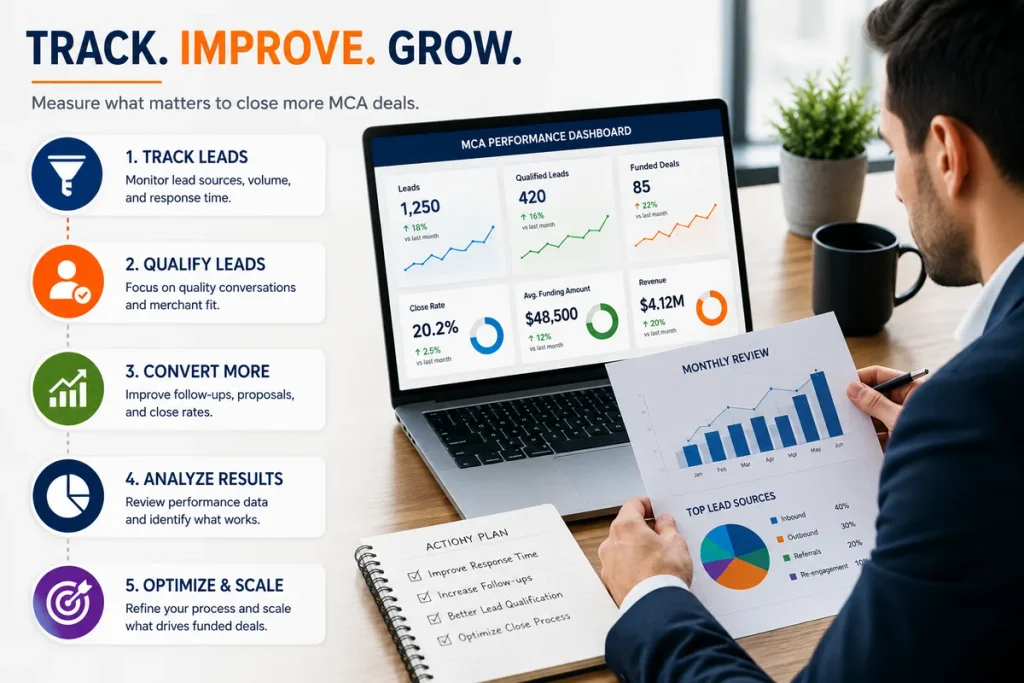
Track results by lead source, merchant niche, sales representative, and funder. Use the same measurement period and denominator so the numbers are comparable.
| Metric | How to calculate it | Why it matters |
| Cost per lead | Total acquisition spend ÷ leads received | Shows the cost of starting conversations |
| Contact rate | Merchants reached ÷ leads received | Shows lead accuracy and response performance |
| Application rate | Completed applications ÷ leads received | Shows sales qualification quality |
| Submission rate | Files submitted ÷ completed applications | Shows document completion and funder fit |
| Approval rate | Approved files ÷ submitted files | Shows file quality and funder matching |
| Funding rate | Funded deals ÷ submitted files | Shows how often submitted files become revenue |
| Cost per funded deal | Acquisition spend ÷ funded deals | Shows acquisition efficiency |
| Average gross commission | Gross commissions ÷ funded deals | Shows revenue per funded transaction |
| Clawback rate | Clawed-back commissions ÷ paid commissions | Shows commission risk |
| Renewal rate | Merchants who renew ÷ eligible funded merchants | Shows long-term merchant and funder value |
| Net contribution | Commissions received minus lead, media, labor, refund, and clawback costs | Shows actual profitability |
Review results by cohort. For example, group all leads from one source in the same month, then follow that group until the deals fund or close. This avoids comparing brand-new leads with older leads that already had time to convert.
Scale only when a lead source produces repeatable net profit, not after a few early funded deals. Before increasing spend, confirm that your team can respond quickly, collect documents properly, manage follow-up, and absorb possible commission clawbacks.
The amount depends on your model. A new broker needs operating capital to build a compliant sales process and generate leads. A direct funder needs operating capital and capital to purchase merchants’ receivables.
Do not rely on a generic claim that there is one fixed cost to start an MCA business. Build your budget around your model, target states, sales plan, and the number of months you can operate before commissions become consistent.
A broker or ISO does not need capital to fund merchants directly. You still need enough cash to operate professionally and test lead generation without depending on one funded deal to cover the following month’s expenses.

Build the launch budget in three parts.
| Budget area | What it covers |
| One-time setup | Entity formation, legal review, website, branding, CRM setup, phone system, and document process |
| Monthly operating costs | CRM, phone, email, document storage, staff or contractor costs, accounting, and compliance support |
| Lead-generation reserve | Lead purchases, paid ads, SEO, referral development, or outbound prospecting tests |
Keep a reserve for several months of operating costs and lead testing. Your requirement may be lower if you sell personally and build referral or organic channels. It may be higher if you hire representatives, buy real-time leads, run paid ads, or target several states at once.
Use this planning formula:
Startup cash needed = one-time setup costs + monthly operating costs × reserve months + lead-generation test budget
Do not spend the full budget on leads before you have funder relationships, a CRM, secure document collection, and a clear qualification workflow.
A direct funder needs a different financial plan. Funding capital is only one part of the requirement.
A direct funder needs resources for:
The amount advertised to merchants should not equal all of the capital available to the company. A funder also needs liquidity for operating costs and slower-than-expected collections.
Before funding directly, model a conservative scenario. Consider what happens if several merchants in the same industry have declining revenue, request reconciliation, miss remittances, or need legal follow-up at the same time. If the company cannot absorb that outcome, direct funding is premature.
Brokering first gives new operators time to learn underwriting, funder requirements, merchant communication, and renewal behavior before taking portfolio risk.
Leads are wasted when you do not yet have funder agreements, a qualification script, secure document collection, and CRM follow-up. A lead becomes useful only when your team can respond, qualify the merchant, and move the file to a clear next step.
A merchant may need capital urgently and still be a poor fit for another MCA. Pushing weak files leads to more declines, merchant frustration, and damaged funder relationships.
Do not send every application to every funder. Review the merchant’s industry, deposits, existing obligations, location, and request first. Submit only to funders whose credit box is a realistic match.
A large gross commission is not final profit if a funder can claw it back after an early default or cancellation. Read each funder agreement, track when commissions become secure, identify transactions still at risk, and understand who owns the renewal opportunity.
Do not promise approval, the lowest rate, flexible payments, no fees, or government-backed funding unless the statement is accurate and supported by the actual offer. Marketing, sales calls, and follow-up messages should reflect your real role and the funder’s terms.
A low-cost lead that never becomes an application is not profitable. Measure contact rate, application rate, submitted files, approvals, funded deals, commissions received, clawbacks, and net contribution by lead source.
Do not hire a larger sales team or multiply lead spend until the existing process can handle documents, funder submissions, offer explanations, follow-up, and merchant questions consistently.
A 90-day plan should build the business in stages. Each phase should be working before you add more volume.
The first month is for building a business that can receive and handle merchant files professionally.
Move to the next phase when you have a basic funder network, a secure way to collect documents, and a defined process from lead to submission.
The second month is for learning what a qualified file looks like and where the process breaks down.
Move to the next phase when you can manage merchant files consistently, explain the funding process accurately, and identify which lead sources and merchant types produce fundable opportunities.
The third month is for identifying what works before you increase spend.

By day 90, you should know which merchant profile you serve best, which funders fit those merchants, which lead sources create real applications, and whether the business can grow without weakening compliance or merchant experience.
Merchant cash advances can be legal when they are properly structured and operated under applicable federal and state rules. Whether a transaction is lawful depends on the agreement, disclosures, reconciliation practices, collection behavior, and the conduct of the broker or funder, not simply on calling it an MCA.
Possibly. Requirements depend on your role, the merchant’s state, the transaction structure, and the activities you perform. Brokers, ISOs, and direct funders can have different obligations, so forming an LLC does not automatically allow you to operate nationwide.
Yes, but begin as a broker or ISO rather than a direct funder. Learn how to qualify merchants, review bank statements, work with funders, explain offers accurately, and follow applicable marketing and disclosure requirements before taking portfolio risk.
An MCA broker introduces qualified merchants to funders and earns a commission when a deal funds. A direct funder provides capital, controls underwriting and agreements, services the transaction, manages collections, and carries the risk of losses.
An MCA broker does not need capital to fund merchant advances. You do need enough money for business formation, legal and compliance review, CRM and document tools, lead generation, sales activity, and several months of operating costs while you test the process.
MCA brokers can earn strong commissions when they submit qualified merchants who fund and build dependable funder relationships. Profit depends on commissions received after lead costs, marketing, sales labor, refunds, and clawbacks. High lead volume does not guarantee income.
Broker risks include poor-quality leads, low funding rates, commission clawbacks, compliance mistakes, and damaged funder relationships. Direct funders also face underwriting losses, fraud, servicing costs, collection issues, legal exposure, and portfolio concentration.
Not automatically. States can have different commercial-financing disclosure, registration, marketing, and broker requirements. Review each target state before advertising, accepting applications, brokering, or funding transactions there.
MCA brokers find merchants through search marketing, paid ads, verified leads, live transfers, referral partners, compliant outbound outreach, networking, and renewal follow-up. The best source produces qualified applications, funded deals, and net profit, not simply the lowest cost per lead.
Most funders request a completed application, recent business bank statements, identification, a voided business check, and details of existing financing. Depending on the file, they may also request payment-processing statements, business formation documents, tax returns, lease information, or proof of revenue.
There is no single official government figure for the entire MCA industry because providers, brokers, funders, and transaction structures vary. The Federal Reserve’s 2026 Small Business Credit Survey shows continued financing demand: 38% of employer firms applied for a loan, line of credit, or cash advance in the previous 12 months. That figure shows demand for financing, not the total size of the MCA market.
About Author
Jason Hunt

A premier provider of verified, high-quality Merchant Cash Advance leads, helping funders connect with business owners actively seeking capital since 2013.
115 W California Blvd, Pasadena, ,CA 91105, United States
+1 (646) 741-5747office@mcaleadspro.comCopyright © 2026 MCA Leads Pro. All Rights Reserved.