Blog
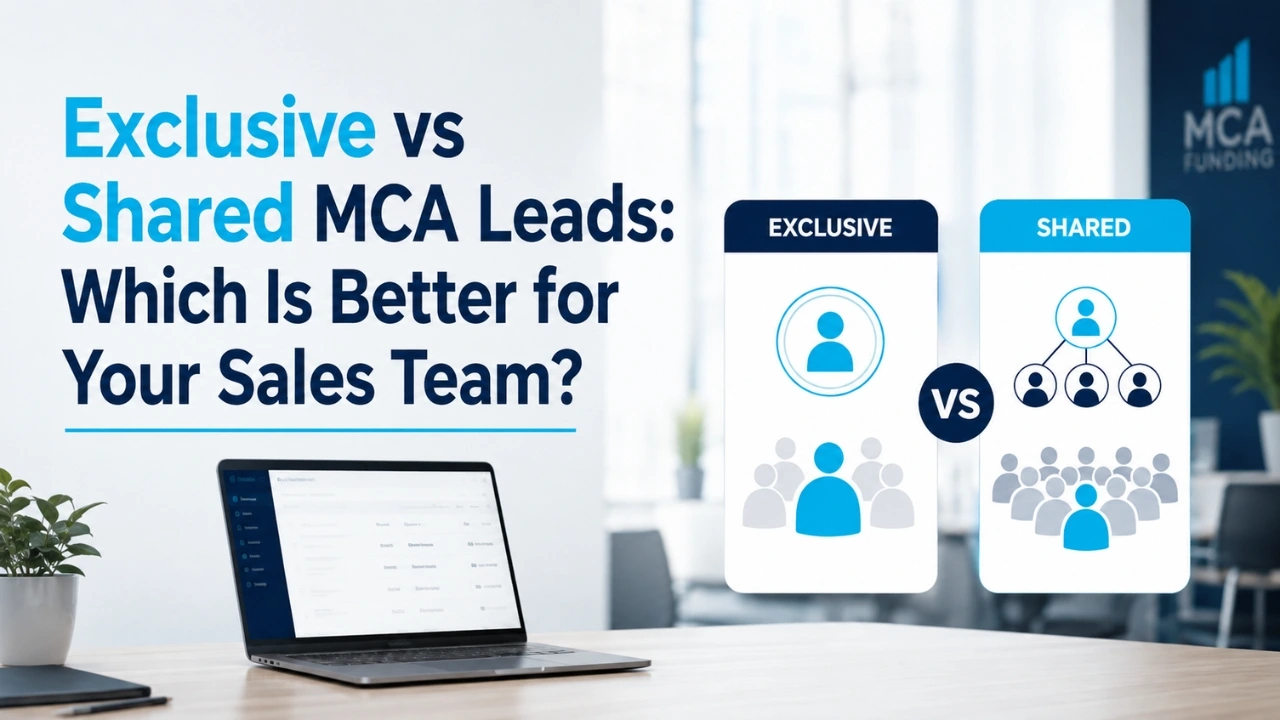
Exclusive and shared MCA leads create different sales economics. An exclusive MCA lead is distributed to one buyer under the provider’s exclusivity policy. A shared MCA lead can be distributed to multiple brokers, Independent Sales Organizations (ISOs), or funders.
That difference affects more than cost per lead. It changes direct competition, response pressure, sales-rep workload, lead utilization, and the cost required to generate qualified merchants, submissions, and funded deals.
Exclusive leads generally give your sales team more control over each opportunity. Shared leads provide more prospect volume for the same acquisition budget.
Neither model is automatically more profitable. The better choice depends on lead source, merchant fit, sales capacity, response speed, qualification criteria, and total acquisition cost.
Exclusive MCA leads are distributed to one buyer under defined exclusivity terms, while shared MCA leads can be delivered to multiple buyers. Exclusive distribution reduces competition created by the lead provider. Shared distribution lowers the initial acquisition cost but puts more pressure on response speed and sales execution.
| Factor | Exclusive MCA Leads | Shared MCA Leads |
| Distribution | One buyer under stated terms | Multiple buyers |
| Provider-created competition | Lower | Higher |
| Cost per lead | Higher | Lower |
| Response pressure | Important | Critical |
| Lead volume per budget | Lower | Higher |
| Merchant contact saturation | Lower | Higher |
| Sales attribution | Easier to isolate | Harder to isolate |
| Best starting fit | Quality-focused teams | High-volume sales operations |
The biggest benefit of exclusivity is not a guaranteed close. It is greater control over the opportunity after delivery.
However, exclusive does not mean your company is the only MCA company speaking with that merchant.
There are two types of competition MCA lead buyers should understand:
Exclusive distribution primarily reduces provider-created competition. A merchant can still submit another inquiry elsewhere, so no provider can guarantee that your sales team will face zero market competition.

Exclusive MCA leads are not automatically higher quality than shared leads. Exclusivity describes how an opportunity is distributed. Lead quality depends on merchant intent, freshness, contact accuracy, source, qualification criteria, verification, and the integrity of the underlying merchant information.
A poor record does not become valuable because only one buyer received it.
MCA buyers should evaluate these attributes independently:
| Lead Attribute | What It Tells You |
| Merchant intent | Whether the business is currently exploring working capital |
| Freshness | How recently the merchant expressed interest |
| Contact accuracy | Whether supplied contact details are usable |
| Qualification | Whether the merchant meets defined campaign criteria |
| Verification | Which merchant details or expressions of interest have been checked |
| Lead source | How the opportunity entered the lead-generation process |
| Exclusivity | How the provider distributes the opportunity |
This distinction helps buyers compare the actual opportunity rather than relying on labels such as “exclusive” or “premium.”
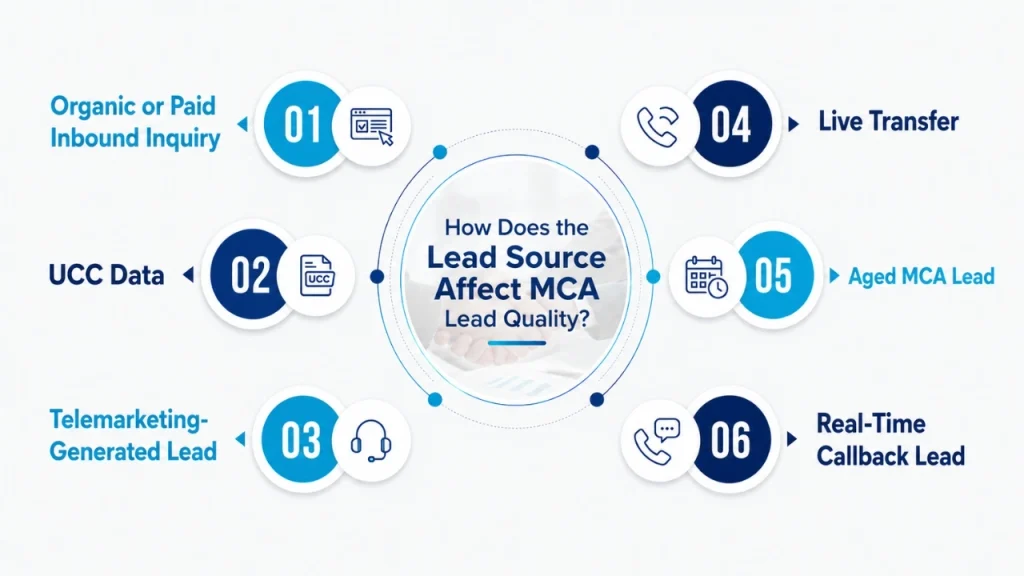
Lead source matters because different acquisition methods represent different levels and types of merchant intent. An inbound funding inquiry, UCC-based prospecting record, live transfer, and aged inquiry can all be sold as MCA leads, but they do not represent the same sales situation.
| Lead Source | What It Usually Represents | What Buyers Should Evaluate |
| Organic or paid inbound inquiry | Merchant actively submitted an inquiry | Freshness, qualification, distribution |
| Live transfer | Merchant connected directly with a sales team after qualification steps | Qualification criteria, verification, transfer process |
| Telemarketing-generated lead | Merchant interest identified or confirmed through outbound contact | Verification process, campaign criteria, applicable outreach procedures |
| UCC data | Business with a public financing-related filing history | Filing date, business accuracy, current intent, prospecting strategy |
| Aged MCA lead | Merchant that expressed interest previously | Lead age, data accuracy, follow-up potential |
| Real-time callback lead | Recent merchant inquiry delivered for immediate follow-up | Delivery speed, qualification, exclusivity |
A lead source should therefore be evaluated separately from its distribution model.
For example, an exclusive UCC record still does not demonstrate the same current funding intent as a recent inbound inquiry. Likewise, a shared real-time inquiry may contain stronger current intent than an exclusive record generated months earlier.
Source + freshness + qualification + verification + distribution provide a better picture of the opportunity than exclusivity alone.
Lead quality and campaign fit are also different. Lead quality describes the integrity and usefulness of the merchant opportunity. Campaign fit describes whether that merchant matches the specific criteria your sales team or funding operation wants to pursue.
A fresh, verified merchant can still be a poor fit for a particular campaign.
For example, a merchant may have:
That can represent a quality opportunity.
But if your campaign only targets merchants with higher monthly revenue, selected industries, specific states, a particular requested funding amount, or certain existing funding positions, that merchant may not fit your campaign.
Qualification criteria can include:
This is why buyers should not ask only, “Are these leads good?”
A more useful question is:
“Are these leads good for our underwriting appetite and sales process?”
Lead qualification is still different from underwriting. A qualified lead may satisfy preliminary campaign criteria, while detailed financial review and bank statement analysis occur later when the merchant enters the submission and underwriting process.
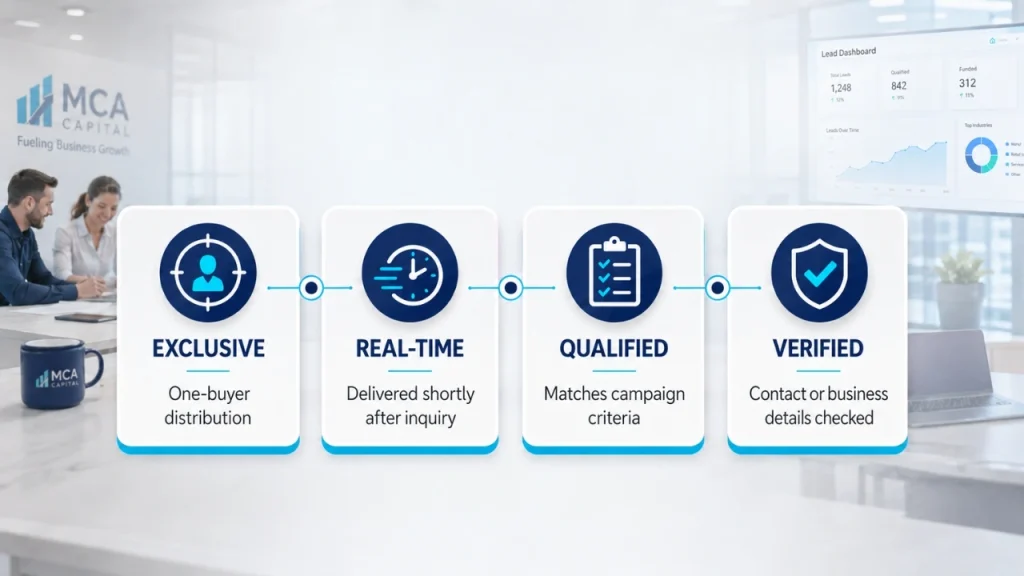
Exclusive, real-time, qualified, and verified MCA leads are not the same. Exclusive describes how a lead is distributed, real-time describes when it is delivered, qualified describes whether the merchant matches campaign criteria, and verified describes whether specified merchant or contact information has been checked.
Understanding these differences helps MCA brokers and funders compare lead products accurately instead of treating several lead attributes as interchangeable.
| Lead Attribute | What It Means | What It Tells the Buyer |
| Exclusive | The lead is distributed according to a defined one-buyer exclusivity policy | How the provider controls distribution and direct buyer competition |
| Real-time | The lead is delivered shortly after the merchant inquiry or lead-generation event | How fresh the opportunity is at delivery |
| Qualified | The merchant meets predefined campaign criteria | Whether the opportunity fits the buyer’s targeting requirements |
| Verified | Specified contact details, business information, or merchant interest have been checked | What information has gone through the provider’s verification process |
These attributes can overlap without meaning the same thing. A real-time lead can be shared, an exclusive lead can be aged, and a qualified lead can be either shared or exclusive.
MCA sales teams should therefore ask providers to define distribution, freshness, qualification, and verification separately before comparing lead products.
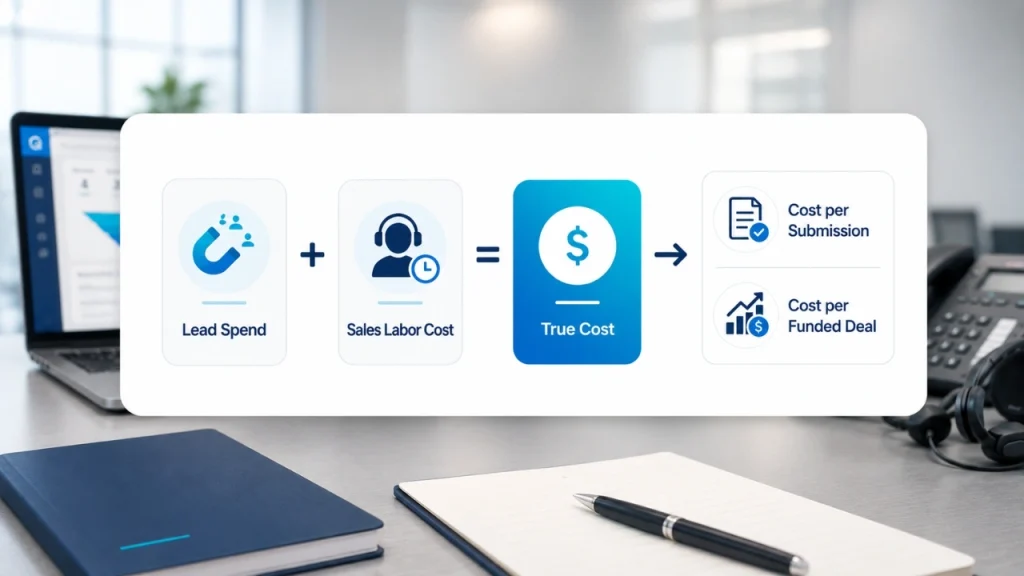
Exclusive MCA leads generally cost more per lead because the provider assigns the opportunity to one buyer rather than distributing the acquisition cost across several customers. Shared MCA leads normally have a lower upfront CPL, but the lower lead price does not automatically produce a lower Cost Per Acquisition (CPA).
CPL measures the price of getting an opportunity into the pipeline.
It does not show how much sales effort is required to turn that opportunity into a qualified conversation, submission, or funded deal.
MCA sales teams should evaluate lead spend and sales labor together. A shared campaign can appear affordable until closers spend substantial time redialing merchants who are already speaking with several competitors or cannot be reached.
A useful formula is:
True cost per submission = (Lead spend + allocated sales labor cost) ÷ completed submissions
The same principle applies farther down the funnel:
True cost per funded deal = (Lead spend + allocated sales labor cost) ÷ funded deals
Consider this hypothetical comparison:
| Metric | Shared Campaign | Exclusive Campaign |
| Leads purchased | 100 | 40 |
| Lead spend | $2,000 | $2,000 |
| Rep hours used | 20 | 8 |
| Internal rep cost | $30/hour | $30/hour |
| Sales labor cost | $600 | $240 |
| Total acquisition cost | $2,600 | $2,240 |
| Completed submissions | 6 | 6 |
| True cost per submission | $433 | $373 |
These numbers are illustrative, not industry performance benchmarks.
Both campaigns generated six submissions from the same lead budget. The difference appears only after sales labor is included.
For an MCA operation where experienced closer time is limited or expensive, that hidden cost can materially change which lead source performs better.
More MCA leads do not automatically create more opportunities. Lead volume only has economic value when the sales team can work the inventory within the campaign’s intended response and follow-up process.
This creates an important sales-floor metric:
Lead utilization rate = Leads properly worked within the planned first-touch window ÷ Leads delivered × 100
If your provider delivers 300 leads but your team properly works only 210 within the intended first-touch period:
210 ÷ 300 = 70% lead utilization
Thirty percent of the purchased inventory did not receive the planned sales execution.
This problem can make an inexpensive shared campaign costly. It can also waste premium exclusive inventory when a team purchases more opportunities than its closers can manage.
The objective should not be maximum lead volume.
It should be the maximum usable lead volume.
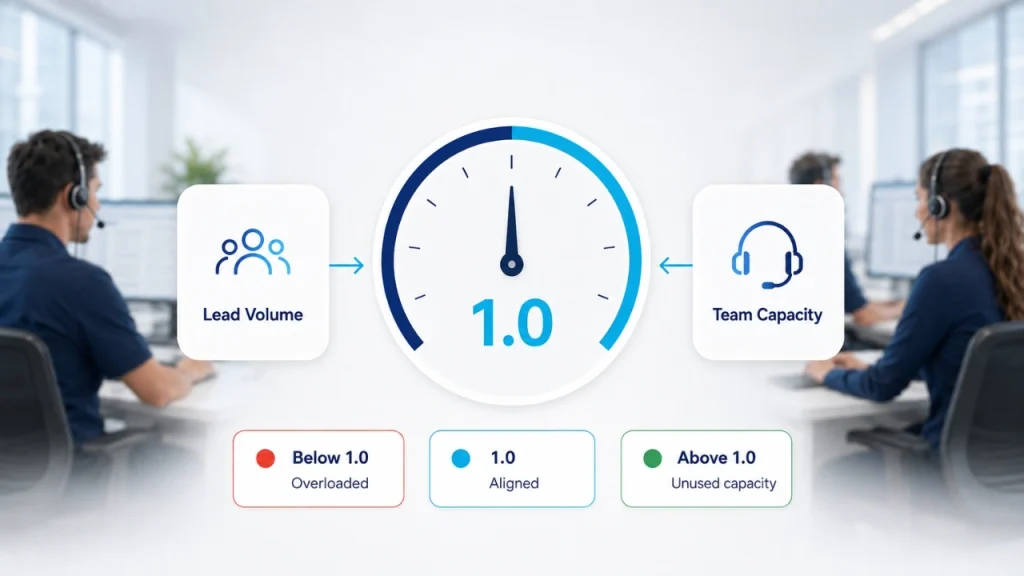
Response-capacity fit measures whether your lead delivery volume matches the number of opportunities your sales team can properly work.
Use:
Response-capacity ratio = Leads your team can properly work within the target response window ÷ Leads delivered during that period
A ratio of 1.0 means planned sales capacity and lead volume are aligned.
A ratio below 1.0 means leads are arriving faster than the team can properly process them.
A ratio above 1.0 indicates unused sales capacity.
This metric does not measure lead quality. It measures whether the product fits the operation buying it.
A large sales floor with unused dialing capacity may extract strong value from shared volume. A smaller team with experienced closers may perform better by concentrating on fewer opportunities with lower provider-created competition.
Exclusive MCA leads usually fit teams that value rep efficiency, lower direct distribution competition, clearer campaign attribution, and greater control over merchant follow-up. They become especially useful when experienced closer capacity is the limiting resource rather than the number of available leads.
Exclusive MCA leads may be the better fit when:
A brokerage should not optimize for the lowest CPL when closer time is its most expensive sales resource.
If a rep can properly work 40 opportunities in a day, purchasing 100 because the leads cost less does not automatically improve performance. The additional inventory only creates value when another rep, dialer workflow, or structured follow-up system can absorb it.
Exclusive leads can therefore solve both a competition problem and a capacity-allocation problem.
They still do not guarantee funded deals. Merchant fit, underwriting, available offers, sales execution, response time, and follow-up determine what happens after delivery.
Shared MCA leads can make sense for sales operations built around volume, rapid response, and persistent follow-up. Their lower initial acquisition cost allows teams to put more prospects into the pipeline, but the buyer needs sufficient sales capacity to compete for merchant attention.
Shared leads can fit:
Shared leads can also be useful for testing campaign fit.
If you are entering a new industry, revenue segment, funding range, or state, you may want to validate your contact, qualification, and submission economics before allocating more budget to exclusive opportunities.
Run the test first.
Then move the budget toward the source producing the stronger downstream economics.
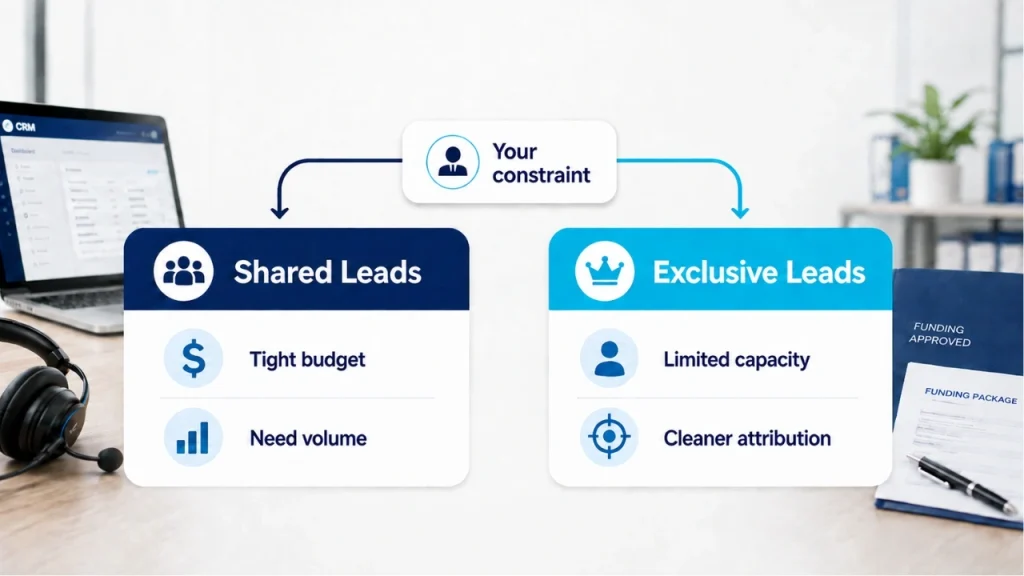
MCA brokers should choose between exclusive and shared leads using three constraints: acquisition budget, sales capacity, and funnel performance. Cost per lead is only an input. The final decision should reflect how efficiently each source produces usable conversations, submissions, and funded deals.
| Your Situation | Better Starting Option |
| Lead budget is the main constraint | Shared |
| Experienced closer capacity is the main constraint | Exclusive |
| You have unused dialing capacity | Shared |
| Current lead volume exceeds rep capacity | Exclusive or lower overall volume |
| You are testing a new segment | Shared |
| You need cleaner campaign attribution | Exclusive |
| Your team responds quickly and handles volume well | Shared |
| Shared distribution is creating excessive direct competition | Exclusive |
| Sales labor cost is high | Compare true acquisition cost |
| You do not have enough performance data | Run a controlled comparison |
A controlled test provides better information than assumptions about either lead type.
Keep the qualification criteria and sales process as consistent as possible, then compare:
This framework measures both lead performance and sales-floor efficiency.
A source that wins on CPL but loses on utilization, rep hours, qualification, submissions, and funded-deal economics is not necessarily the lower-cost campaign.
Before buying exclusive MCA leads, define exactly what the provider means by exclusivity. A one-buyer label tells you little about the merchant’s source, freshness, qualification, future resale policy, or fit with your underwriting criteria.
Ask these questions before purchasing:
Exclusivity does not replace compliance. MCA lead buyers remain responsible for ensuring their own calling, texting, email, and follow-up practices comply with applicable TCPA, DNC, and other communication requirements.
A credible MCA lead provider should be able to explain where the leads come from, how they are qualified, what gets verified, when they are delivered, and how they are distributed.
MCA Leads Pro works with brokers, Independent Sales Organizations, funders, and MCA sales teams that need lead flow aligned with their sales operation rather than generic bulk data.
Our lead solutions include MCA live transfer leads, real-time MCA leads, and aged MCA leads. Each product supports a different combination of sales capacity, response speed, campaign criteria, and acquisition budget.
Experienced closers can use live transfers to speak directly with qualified merchants. Teams equipped for immediate outbound follow-up can use real-time callback leads, while high-volume prospecting operations can use aged MCA leads when cost and scale are the priority.
MCA Leads Pro uses multi-channel lead generation, phone verification, DNC filtering for applicable products, campaign targeting, and dedicated account management. The company brings more than 13 years of MCA industry experience, has delivered 80,000+ verified leads, and has served 150+ funders.
No lead provider can guarantee funded deals. Results depend on merchant fit, underwriting criteria, available offers, sales execution, response time, and follow-up.
Contact MCA Leads Pro to discuss your campaign criteria and choose a lead product that fits your sales capacity.
Exclusive MCA leads can justify the higher CPL when reduced competition and better sales efficiency produce stronger downstream economics. Compare qualified merchants, submissions, rep hours, and true cost per funded deal rather than evaluating the campaign on lead price alone.
No. Exclusivity controls how one provider distributes its lead. The merchant can independently contact other brokers or submit inquiries elsewhere. Exclusive delivery reduces provider-created competition, but it cannot eliminate broader market-created competition.
The number depends on the provider’s distribution policy. Ask for the maximum buyer count before purchasing rather than assuming all shared MCA leads follow the same distribution model.
No. Exclusivity measures distribution, not quality. Merchant intent, freshness, source, contact accuracy, qualification, verification, and campaign fit should all be evaluated separately.
No. Real-time refers to when the lead is delivered, while exclusive refers to how it is distributed. A real-time MCA lead can be exclusive or shared depending on the provider’s distribution model.
Yes. Shared leads can work for teams with sufficient call capacity, rapid response, structured follow-up, suitable underwriting, and strong sales execution. Their main tradeoff is greater competition for the same merchant opportunity.
Lead utilization rate is the percentage of delivered leads your sales team actually works within the planned first-touch window. Tracking it shows whether lead volume matches your practical sales capacity.
A qualified MCA lead meets the criteria established for the campaign. These can include monthly gross revenue, time in business, industry, requested funding amount, geography, and other buyer-specific requirements. Qualification does not mean the merchant has completed underwriting or is guaranteed to receive funding.
True cost per funded deal is the strongest final commercial metric. Sales teams should also track lead utilization, rep hours, cost per qualified merchant, and cost per submission to understand where each source creates or loses efficiency.
Get a custom quote built around your states, industries and volume.